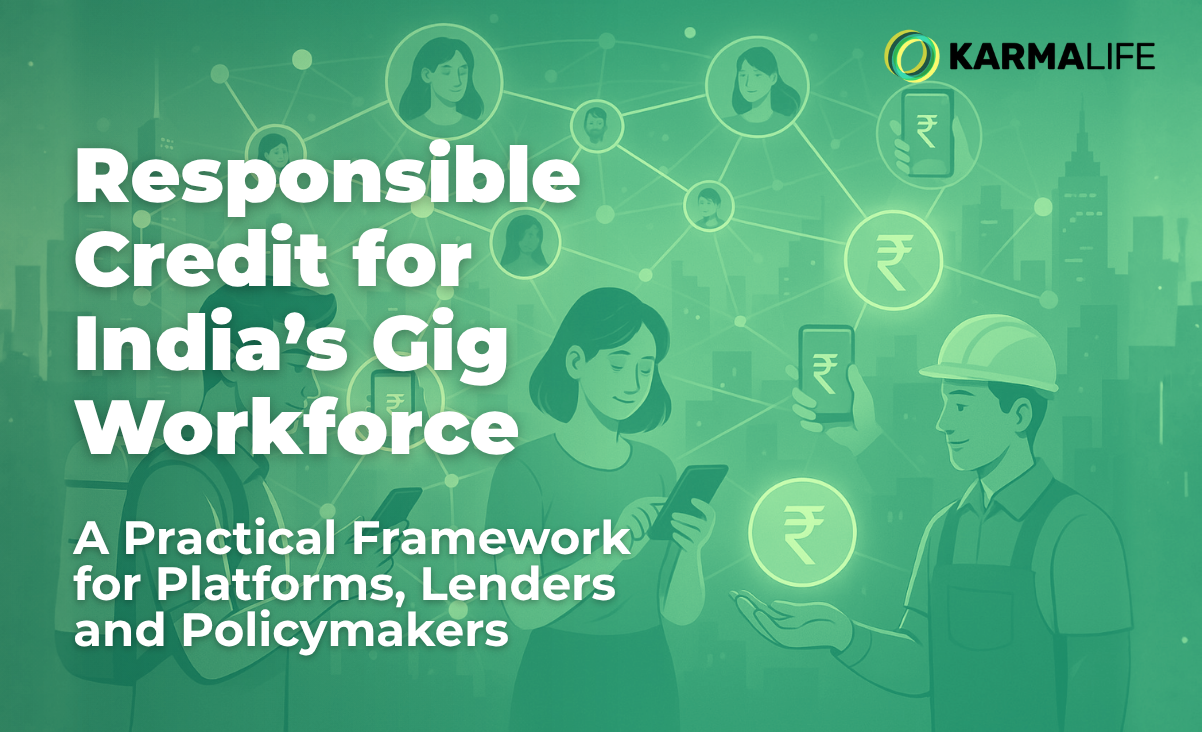
A Practical Framework for Platforms, Lenders and Policymakers
1. Executive Summary
Platform-based gig work has become a permanent pillar of India’s economy. Delivery partners, drivers, beauticians, warehouse staff and on-ground gig workers keep urban India running – yet their financial lives remain fragile and under-served.
Income is volatile, expenses are predictable, and when the two don’t meet, many workers fall back on informal lenders, expensive short-term loans or advance requests that strain employer cash flows. The result is a quiet but costly cycle: stress, absenteeism, accidents, and churn.
This whitepaper offers a practical framework for responsible credit in the gig economy – not as a charter to sign, but as guidance that platforms, employers, lenders and fintechs can adapt to their own context.
It explains:
- The current reality of credit for gig workers
- Why employers, platforms and lenders should care – in both human and hard business terms (retention, productivity, safety, working capital relief, brand trust)
- Core principles of responsible credit in the gig context
- Solution archetypes such as Earned Wage Access (EWA), small-ticket lines of credit and emergency buffers
- A set of guiding practices and an implementation roadmap
The goal is two-fold:
- For workers: Enable gig workers to manage short-term cash gaps without falling into long-term debt traps.
- For businesses: Reduce workforce churn and rehiring costs, improve availability and productivity, offload the burden of manual salary advances and working-capital strain, and strengthen employer brand and ESG outcomes.
2. The Rise of the Gig Workforce – and Its Financial Reality
Over the last decade, India has seen explosive growth in platform-based work: logistics, quick commerce, ride-hailing, hyperlocal services, staffing and facilities management. For millions of workers, gig work offers:
- Flexible hours
- Easy entry and low paperwork
- The ability to earn based on effort
But this flexibility comes with a specific financial pattern:
- Irregular cash flows: Daily or weekly payouts that can fluctuate sharply with demand, incentives, peak pricing and seasonality.
- Thin buffers: Limited savings to absorb shocks such as health issues, family emergencies or vehicle repairs.
- Limited access to formal credit: Traditional lenders rely on salary slips, long credit histories and collateral – which many gig workers lack.
When an unexpected expense or income dip hits, workers must plug the gap quickly. The problem is how they do it.
For employers, these patterns show up in business metrics: last-minute shift cancellations, higher accident risk when workers overwork to repay debt, and sudden drops in availability during high-stress months or festivals.
3. The Problem: The Current Credit Landscape for Gig Workers
Today, many gig workers rely on a fragile patchwork of options:
- Informal moneylenders and local credit: Accessible and fast, but often opaque, with very high effective interest rates and social pressure.
- Overlapping app-based loans: Multiple small-ticket digital loans taken from different apps, with high fees and aggressive collections.
- Salary advances / manual payouts: Requesting advances from supervisors or HR, which creates friction, paperwork and bias – and ties up the employer’s working capital.
- Delayed or missed bills: Skipping essentials or minimum dues, leading to penalties and long-term financial damage.
This landscape creates three systemic risks:
- Debt spirals for workers – juggling multiple loans, late fees and social obligations.
- Operational risk for platforms – more absenteeism, lower availability, higher accident risk and churn when stress peaks, especially mid-month or pre-festival.
- Financial and process strain for employers – constant manual advance management and short-term payouts putting pressure on working capital and finance teams.
- Reputational and regulatory risk – associations with predatory or opaque lending practices to vulnerable populations.
The solution is not “more credit” but better designed, better governed credit that respects the constraints and data realities of gig work, while clearly improving business outcomes.
4. Why Platforms and Employers Should Care
Responsible credit is often framed as a social good. It is that – but it is also a clear business lever.
1. Retention and rehiring cost
When workers leave due to financial stress, platforms pay again for sourcing, onboarding, training and ramp-up time. Reducing stress-induced churn directly saves cost and stabilises service quality.
2. Reliability and customer experience
Financially stressed workers are more likely to miss shifts, cancel at the last minute or work distracted. For categories that depend on on-time fulfilment, this hits NPS and revenue.
3. Productivity and shift utilisation
Workers who have a reliable safety net are more willing to take peak slots, longer routes or additional shifts. Better liquidity design can translate into higher active days, higher orders per worker and improved unit economics.
4. Working capital and process relief
When companies rely on manual salary advances or ad-hoc payouts to help workers, finance teams absorb the complexity and the balance sheet carries the strain. Partnering on structured, earnings-linked solutions can offload much of this burden to specialised providers with clearer rules and automated workflows.
5. Safety and compliance
Fatigue, overworking to repay debt, or driving longer hours to cover repayments can increase accidents and incidents – with both human and legal consequences.
6. Employer brand and ESG
Investors, regulators and consumers increasingly expect platforms to treat frontline workers responsibly. A clear stance on ethical, fair credit and liquidity support becomes part of the organisation’s social licence to operate and strengthens ESG narratives.
In short, responsible credit is workforce infrastructure and a business performance lever, not a side perk.
5. Principles of Responsible Credit for Gig Workers
The gig context is unique: earnings are granular, digital, and often visible to platforms and partner fintechs in real time. That creates an opportunity – and a responsibility – to design better credit.
A responsible approach to credit for gig workers can be built on these principles:
- Transparency and Simplicity
- Clear, upfront disclosure of all fees and charges, in simple language and local languages.
- No hidden conditions, pre-checked add-ons or confusing promotional pricing.
Business impact: Fewer disputes, complaints and escalations; lower support costs.
- Clear, upfront disclosure of all fees and charges, in simple language and local languages.
- Affordability and Right-Sizing
- Credit limits linked to verified earnings and repayment capacity, not arbitrary maximums.
- Structures that avoid over-leverage, with nudges when utilisation is consistently high.
Business impact: Reduces risk of worker burnout and sudden drop-offs due to unsustainable debt.
- Credit limits linked to verified earnings and repayment capacity, not arbitrary maximums.
- Aligned Repayment Design
- Repayments scheduled in sync with actual cash inflows (daily, weekly or per-settlement).
- Grace mechanisms for low-earning periods without immediate penalties or harassment.
Business impact: More stable earnings for workers, lower volatility in availability and hours worked.
- Repayments scheduled in sync with actual cash inflows (daily, weekly or per-settlement).
- Data Responsibility and Consent
- Use of earnings and platform data only with informed consent and clear purpose.
- Strong safeguards for data privacy and no unauthorised resale or profiling.
Business impact: Protects brand reputation and reduces regulatory exposure.
- Use of earnings and platform data only with informed consent and clear purpose.
- Support over Sanction
- Early, empathetic communication when stress signs appear; options like rescheduling or micro-repayments.
- No coercive, threatening or shaming recovery practices.
Business impact: Sustains long-term relationships with experienced workers instead of churning them out.
- Early, empathetic communication when stress signs appear; options like rescheduling or micro-repayments.
- Financial Capability Building
- In-app or in-workflow nudges that encourage reasonable usage, savings behaviour and avoidance of stacking multiple high-cost loans.
- Content in the worker’s preferred language and format (audio, short video, Hinglish, etc.).
Business impact: Over time, a financially stable workforce is easier to plan with and more productive.
- In-app or in-workflow nudges that encourage reasonable usage, savings behaviour and avoidance of stacking multiple high-cost loans.
- Fair Economics for All Stakeholders
- A sustainable cost structure that works for workers, platforms and lenders – avoiding models that rely on hidden cross-subsidies or perpetual rollovers.
Business impact: Stable partnerships and predictable cost of benefits.
- A sustainable cost structure that works for workers, platforms and lenders – avoiding models that rely on hidden cross-subsidies or perpetual rollovers.
These principles are not theoretical. They can be embedded into concrete product designs.
6. Solution Archetypes That Embody the Principles
In practice, responsible credit for gig workers can take several forms. The most effective stacks tend to combine three layers:
6.1 Earned Wage Access (EWA) / On-Demand Pay
What it is:
Controlled access to already-earned income before the normal payout cycle.
Why it works for gig workers:
- Reduces the need to borrow for mid-month gaps – workers use their own earned money.
- Limits overuse via configurable caps and responsible pricing.
- Integrates with existing payout systems and earnings data.
Business benefits:
- Fewer manual advance requests to supervisors and HR.
- Lower pressure to run frequent off-cycle payouts, freeing up working capital processes.
- Higher mid-month attendance and shift fill-rates, especially around rent and EMI dates.
When implemented with transparent fees and strong usage controls, EWA is often the most responsible first line of defence.
6.2 Small-Ticket Revolving Credit Lines
What it is:
A reusable credit line (for example, ₹10,000-₹50,000) linked to earnings, for planned expenses such as education, vehicle repair or small asset upgrades.
Design requirements:
- Underwritten using earnings patterns and platform tenure.
- Clear, flat pricing with no hidden rollover traps.
- Automatic down-scaling or pauses if repayments strain earnings.
Business benefits:
- Workers can keep their tools and assets (bikes, phones, kits) in good condition, directly supporting reliability and quality.
- More predictable repayment flows reduce default and collection friction that can otherwise damage worker-platform relationships.
6.3 Emergency Buffers and Savings Nudges
What it is:
Simple tools that help workers build micro-buffers: rounding up payouts into a savings pot, festival savings jars, or employer-matched emergency funds.
Impact:
- Reduces dependence on any form of credit over the long term.
- Strengthens the “support, not sanction” philosophy.
- Helps employers maintain continuity during sudden shocks – workers with buffers are less likely to exit abruptly.
Taken together, these layers shift the narrative from “workers taking loans” to workers having structured access to liquidity and resilience tools designed around their reality – and to employers benefiting from a more stable, available and productive workforce.
7. Case Snapshots (Illustrative)
To bring the framework to life, consider three typical use cases (with indicative outcomes):
Case Snapshot A: Quick Commerce Platform
- Challenge: High early-tenure churn; many riders leaving after 2-3 months citing money pressure and emergency needs.
- Intervention: Introduced EWA for active riders, enabling access to accrued earnings, with a small, transparent fee.
- Outcomes over 6-9 months (illustrative):
- Lower mid-month dropout rates.
- Improved shift fill-rates in the last week of the month.
- Fewer manual salary advance requests to area managers, reducing admin load and working capital volatility.
- Lower mid-month dropout rates.
Case Snapshot B: Facility Management Company
- Challenge: Workers taking informal loans for school fees and medical expenses, leading to frequent absenteeism.
- Intervention: Partnered with a responsible credit provider to offer earnings-linked lines of credit, plus basic financial education through WhatsApp and in-person sessions.
- Outcomes (illustrative):
- Reduction in short-notice absenteeism and unplanned overtime costs.
- Higher willingness to take longer-term contracts.
- Better employer reputation in worker communities, aiding hiring.
- Reduction in short-notice absenteeism and unplanned overtime costs.
Case Snapshot C: Staffing Firm
- Challenge: Unpredictable demand cycles; workers strained in lean periods and overspending in peak seasons.
- Intervention: Introduced a combined stack: on-demand pay + savings jars for festivals + optional small-ticket credit with income-based limits.
- Outcomes (illustrative):
- More stable active worker base across seasons.
- More balanced usage – workers drawing down less credit when savings pots exist.
- Smoother scheduling and less last-minute scrambling to fill roles.
- More stable active worker base across seasons.
These examples demonstrate that responsible credit is measurable: in retention, productivity, workforce stability, and worker satisfaction.
8. A Responsible Credit Framework for Gig Workers
This section offers practical guidelines for organisations that want to embed responsible credit practices into their worker ecosystem.
Organisations aiming to practice responsible credit can use the following statements as design checkpoints:
- Clarity First
Ensure that any credit, advance or on-demand pay product associated with our workers is explained in plain language, with all fees transparent upfront. - Earnings-Linked Limits
Support credit products that link limits and repayment schedules to verified earnings, reducing the risk of over-leverage and sudden drop-offs. - Fair Collections and Support
Expect respectful, regulator-aligned recovery practices from financial partners, with a preference for early support and restructuring over harsh sanctions. - Data with Dignity
Share worker data with financial partners only under explicit consent, for clear, mutually agreed purposes, and with strong privacy safeguards. - Responsible Partnerships
Periodically review financial providers for pricing fairness, compliance and customer experience outcomes. - Building Capability, Not Dependence
Encourage tools and content that help workers build savings, understand credit and avoid unhealthy borrowing patterns. - Continuous Measurement
Track key indicators – usage, stress signals, complaints, repeat borrowing patterns – and adjust product design when negative trends appear. - Shared Accountability
Recognise that responsible credit is a shared responsibility between platforms, lenders, and fintech partners – and we collaborate to resolve issues quickly and fairly.
These practices are meant as guidance, not prescription. Each organisation can adapt them based on sector, worker profile and regulatory environment.
9. Implementation Roadmap for Platforms/ Employers
For organisations that wish to embed responsible credit practices using this framework, the journey can follow four phases:
Phase 1 – Diagnose
- Map your current landscape: advances, informal lending patterns, partner complaints, existing fintech tie-ups.
- Run a Financial Stress & Liquidity Survey with a sample of workers.
- Quantify the cost of churn, absenteeism, rehiring and manual salary advances linked to financial stress.
Phase 2 – Design
- Choose the right mix of solutions: EWA, lines of credit, savings tools, insurance.
- Co-create product and policy rules with a responsible provider (limits, pricing, eligibility, caps).
- Align internal stakeholders (HR, operations, finance, legal, compliance) around both worker impact and business KPIs.
Phase 3 – Deploy
- Start with a pilot cohort and clear KPIs (retention, usage, satisfaction, complaints, reduction in manual advances).
- Communicate clearly to workers: eligibility, costs, and responsible usage norms.
- Provide in-app and WhatsApp support in multiple languages.
Phase 4 – Deepen
- Review data and feedback quarterly.
- Adjust caps, limits and education flows based on real behaviour.
- Scale to larger cohorts; integrate success metrics into leadership dashboards.
- Share anonymised learnings with the wider ecosystem to refine responsible practices in the sector.

10. The Way Forward
India’s gig economy will only grow from here. The question is whether its financial foundations will keep pace – or whether millions of workers will continue to depend on fragile, high-cost, informal credit.
Platforms, lenders, investors and policymakers now have the data, technology and tools to do better.
One informed, well-designed credit decision at a time, organisations can create a healthier, more productive gig workforce – and build stronger, more resilient businesses in the process.